000
Martell launch £200k connoisseurs Cognac trunk by Pinel & Pinel
“Crafting cognac is an art in itself, but when Frédéric Pinel (Pinel & Pinel) was commissioned to design the ultimate connoisseur’s trunk for Martell cognac, the resultant creation is a statement of pure cognac indulgence”….
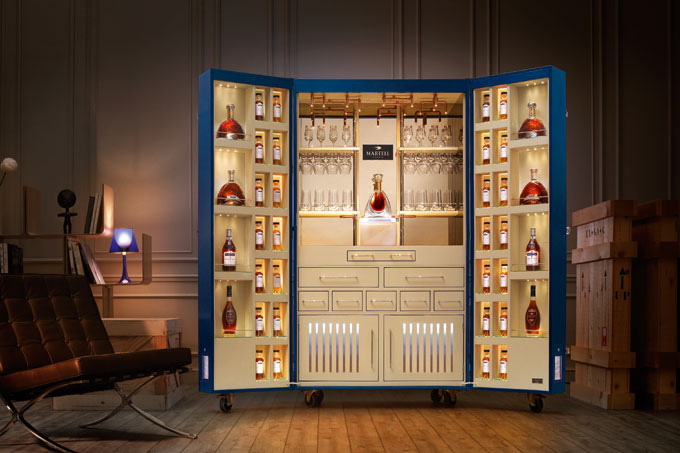
From the original blends in the montres to practically the entire Martell Collection, this magical trunk reveals a world of enchantment, inviting aficionados to savour the Martell cognac experience in a way that has never before even been conceivable.
Amongst the many enchanting delights that lurk behind the leather-clad doors of this handmade trunk, the one that grabbed our attention and most certainly our taste-buds (courtesy of a private tasting session at Harrods) was the truly exquisite….
L’OR DE JEAN MARTELL
L’Or de Jean Martell, consists of a complex blend of several hundred eaux-de-vie, some of which have been meticulously aged for over a century. On the nose, L’Or de Jean Martell offers a vibrant fruity harmony of citrus notes, orange peel and blackcurrants, with aromas of gingerbread where clove and cinnamon are subtly combined with sweet vanilla. Scents of oriental forests round off this aromatic ballet with woody notes of agarwood (oudh) and myrrh, undergrowth and rancio. In the mouth, the attack is smooth yet subtle, followed-up by a more substantial opening of flavours and the the strength and structure of very old Grande Champagne eaux-devie making themselves known. The lingering finish of a “peacock’s tail” effect (found only in the greatest cognacs) makes it an unquestionably memorable experience that will savoured for life. (RRP: £2995)
A far-cry from stigma of Hop-Hop associated contemporaries Hennessy and Courvoisier, Martell has always remained the ‘Prestige Brand’ with a larger share of the XO and above market. Martell’s style has always been about elegance, complexity and balance, refined and perfected with skill and passion over the period of it’s three hundred year history.
The process of Cognac making all begins with checking the wines and tasting them in order to determine whether they are to be distilled. Cru by cru, these clear wines - which have been rid of their lees after the vinification process - undergo a first distillation, which produces a liquid known as brouillis. The brouillis itself is then distilled, a process referred to as la bonne chauffe. In keeping with an age‑old, but unwritten practice handed down through the generations, Martell retains only the best of the resulting distillate: “the heart” or coeur de chauffe. The eaux-de-vie that emerge from the still are kept for at least two years in casks of fine-grained oak, a wood that releases soft, subtle tannins. The clear liquid gradually turns into an amber elixir with a striking bouquet. The development of each eau‑de‑vie and its interaction with the wood is closely watched by the cellar master, preparing the future harmonies of the cognacs. The cognac finally emerges during blending. Year after year, each of the cognacs in Martell’s Collection is meticulously recreated by the painstaking composition of carefully selected eaux‑de‑vie: over a hundred for the Cordon Bleu and several hundred for L’Or de Jean Martell!
Out of the six crus in the cognac AOC (Appellation d’Origine Contrôlée), Martell chooses the four main ones: Grande and Petite Champagne, Fins Bois and Borderies. With 430 hectares under vines, Martell owns the biggest vineyard in the region and gives pride of place to the Borderies cru, which composes its aromatic signature. Although this cru only represents five per cent of the total Charente vineyards, it comprises one third of Martell’s domain and is the smallest of the six crus – a plateau of sandy-clay soil. It dominates the Champagne plain, and its name evokes the woods that used to border the vineyards.
Its eaux-de-vie are marked by roundness and smoothness, and by floral aromas that evolve over time towards notes of candied fruit and sweet spices.
Although the art of cognac starts in the vineyards, continues in the distilling process and then, day after day, in the warehouses, it truly culminates in the heart of the House during the final stage: the blending. This draws on the Martell reserves in the casks stored in the warehouses, or the demijohns where the eaux-de-vie patiently await their turn, sometimes for more than a hundred years 1, in a cellar called “paradise”. Each of Martell’s cognacs is the fruit of a long process during which numerous tests and pre-blends are prepared, in small, cylindrical, 20cl sample bottles known as montres. Beyond being a simple tool of the trade, the montre enables its contents
to be shared and assessed by the cellar master and his assistants.
To illustrate this stage of blending, whilst exacerbating the specificities of the four crus which make up the identity of Martell’s cognacs, to give a taste of the ineffable skill that derives from its experience, intuition and dialogue, Martell has endowed this trunk with twenty-eight montres – or seven examples of four remarkable, unique blends. Each one is a composition that is made to measure, a sensory representation of a terroir.
Sometimes just three or four exceptional eaux-de-vie suffice to bring out a cru’s taste and aroma. Consequently, each eau-de-vie has been chosen for two reasons: its potential to represent its terroir, and, together with the other eaux‑de-vie, which are measured to the closest centilitre, to create the famous Martell balance. Each of the four Exclusive Blends bears the name of its terroir, to which a figure is added. This figure corresponds to the number of vintages – some of which date back several decades – which enter the composition of the montre, bearing in mind that several eaux-de-vie from the same year may be included in the blend. As their intensities of taste differ, they are presented in the cellar master’s recommended tasting order , i.e. from the most subtle to the the most full-bodied.
“So whether intending to create your own cognac blends from the World’s Finest, sampling the entire (well…almost) Martell range, or simply impressing guests with the utmost in luxury connoisseur collections; this trunk will certainly ensure a truly memorable occasion unlike any other. Although please note that there are currently only two in circulation so you will need to have your trunk custom built to order, available exclusively through Harrods”.
Harrods Ltd
87–135 Brompton Rd
Knightsbridge
London, SW1X 7XL
United Kingdom
Tel: +44 (0)20 8479 5100 (International)
Website: www.harrods.com / www.martell.com
Clive Christian - Most Expensive Perfume
The launch of the Clive Christian Perfume House in 1999 heralded the return of luxury perfume to the world stage.
As custodian of the British Crown Perfumery first established in 1872 and uniquely granted the image of Queen Victoria’s crown as a symbol of utmost quality and excellence, Clive Christian has revived the original values of the perfumery, creating only pure perfumes with complex formulae that use the most rare and precious ingredients in their most concentrated forms.
Clive’s connection to this perfumery began 25 years ago when he and his daughter Victoria found an original bottle from the 1800’s hidden deep in the floorboards of their family home. The Crown Perfumery was gradually finding business more and more difficult, and Victoria’s passion for perfume inspired Clive to revive the perfumery, paying fitting tribute to the rich heritage of the brand; it became the house of Clive Christian. Clive Christian’s vision of luxury perfume was ground breaking in that he drew no reference to cost in the creation of his perfumes culminating in the release of the Definitive Collection headlined by No1, recognised by Guinness World Records as The World’s Most Expensive Perfume, which, in its ultimate presentation – No.1 Imperial Majesty – is valued at £215,000. Clive Christian’s 1872, inspired and named as a tribute to the origins of the perfumery, and X, brimming with natures most powerful aphrodisiacs, complete the Definitive Collection. Clive Christian remains the top selling perfume collection at the most prestigious boutiques and perfumeries around the world. Clive Christian Perfumes have always believed in creating harmonious perfumes; one for men and one for women, two perfumes which perfectly complement each other to create a stunning medley of scent; a concept steeped deeply in the heritage of the brand. Queen Victoria is known for her love of fine perfume; she and Prince Albert expressed their love by exchanging gifts, including custom made, harmonising fragrances. Clive Christian Perfume has been commissioned for presentation to TRH The Duke and Duchess of Cambridge on the occasion of their wedding and was chosen by Katie Holmes for her wedding to Hollywood ‘royalty’, Tom Cruise.
After over ten years at the pinnacle of the luxury perfume world, Clive was finally persuaded by loyal clients to release two of his favourite perfumes from his Private Collection – C for Men and C for Women – which officially joined Clive Christian Perfumes in 2011.
Stockists:
Roja Dove Haute Parfumerie, Urban Retreat, 5th Floor, Harrods; 020 7893 8797
Fortnum and Masons; 020 7734 8040 ext. 2147