
Accessories
Clive Christian - No.1 Imperial Majesty
5 Fabulous Facts on No.1 Imperial Majesty…
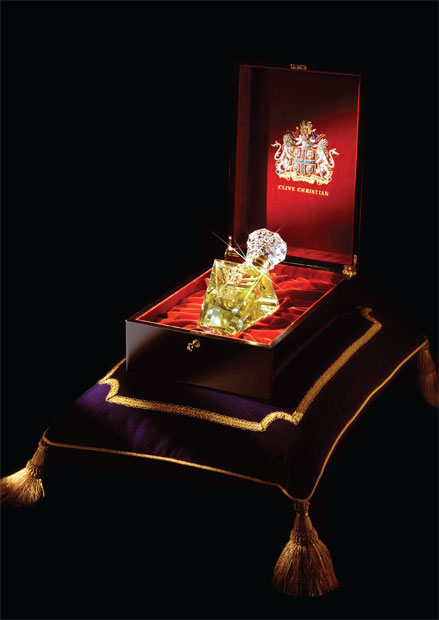
1. No.1 Perfume is The World’s Most Expensive Perfume – created by Clive to restore absolute luxury to the world of perfume. No.1 Imperial Majesty is the ultimate presentation of that perfume.
2. As perfume is ultimately invisible, Clive created a vessel that would epitomize his No.1 Perfume - each ounce is presented in the finest polished crystal bottle, bearing white diamond at the neck; both crystal and diamond being outstanding elements of nature.
3. In every piece of the No.1 Perfume collection – whether it is in the gold bottle of the 1000 piece No.1 Perfume Spray or the feathered and be-jewelled No.1 bespoke bottles created for Sir. Elton John – it is the No.1 Perfume itself that remains the most expensive, and therefore most precious, element of these presentations.
4. ‘No.1 Imperial Majesty’ was created by Clive to serve as a marker in history of the return to luxury perfume creation and a as tribute to The World’s Most Expensive Perfume – the 16 ounces of No.1 Perfume held within remain the most costly element of this presentation also.
5. Clive was presented with a unique award at the 2006 UK FiFi awards for his ‘No.1 Imperial Majesty’ to mark its place in the world of perfume - this had never been awarded before, nor has it since
Richard Mille's RM-027 Tourbillon
The latest mechanical watch from Richard Mille, the RM 027 Tourbillon (www.richardmille.com), is the Swiss company’s first timepiece to weigh in at less than one ounce, strap included. This feat also is the fulfillment of a goal held by Richard Mille himself: the creation of a lightweight tourbillon that tennis pro Rafael Nadal—who collaborated on the project—can wear on the court.
Unveiled in May and limited to 50 pieces, the $525,000 RM 027 employs a lithium-aluminum alloy for the movement baseplate and a carbon composite for the exterior. Such aerospace-grade materials are not new to Mille’s watches—the RM 009 has a case made of the aluminum-and-silicium mixture used in satellites—but they reach their apogee in the RM 027.
Belying the watch’s lightness is its appearance. A network of columns and struts lends the look of a heavyweight to the RM 027 while protecting the tourbillon’s power train from shocks—including those it might sustain at this year’s US Open.
By: Robb Report 01/07/2011
Tag Heuer's exquisite Monaco V4
The V4 featured a TAG Heuer logo etched into the front crystal- a feature that would be dropped on future iterations of the V4.
With the benefit of hindsight, we can now say that the Monaco V4 Concept of 2004 marked a turning point for TAG Heuer. Yes, TAG Heuer had shown some innovative Concept watches before (The Micrograph of 2002 and the Monaco 69 in 2003), but the audacious V4 was the first sign that the “new” TAG Heuer was serious about re-establishing its credentials as a manufacturer and designer of advanced mechanical movements.
Since 2004 TAG Heuer has shown a brace of innovative movements- the Calibre 360, the Pendulum, the Mikrograph and Mikrotimer- but it all started with the V4. So advanced was the V4 that most people though that it would never make it into production for two reasons. Firstly because it was believed that the belt system wouldn’t provide the necessary reliability and secondly because this incredibly innovative system was being put forward by TAG Heuer rather than an established manufacture.
What did TAG Heuer know about designing and making a movement, let alone one as complex as the V4?
The story of the Monaco V4 started out with an R&D think-tank established within TAG Heuer in late 2001. The company was only a few months into its life as part of LVMH and had just appointed a new CEO- Jean-Christophe Babin. As Jean- Christophe told Calibre 11, one of the first things he noticed about TAG Heuer was that the company had lost its reputation as a watchmaker- and he and the new team was determined to re-establish these credentials. The goal was far more ambitious than just designing and building an in-house movement: The goal was to re-invent some of the basic principles of watchmaking………
read more…
By: www.Calibre11.com 22/05/2011
Louis Moinet $4.6m Meteoris Planetarium
You are looking at the one-of-a-kind Meteoris from watch maker Louis Moinet. Meteoris is a set of four watches and this artfully made mechanical planetarium. The set is for the serious astrological and horological connoisseur. Clearly very expensive, the set has some interesting features that are worth knowing about. Looking at the planetarium it is clear that the table like structure is on a pedestal with an ornate mechanical planetarium on it surrounded by four pillow sections for the watches. Actually, Given the complexity of the planetarium, I wish that Louis Moinet would have put more effort into giving the watches more appropriate housings. You have four piece unique watches that are each beautifully made tourbillons that are just sitting there on a pillow. At least give them a dust cover.
The planetarium weighs about 100 kilos and is 150mm tall, and about 91cm in diameter. The table and mechanics where done by the mechanic Rémy Chauvin. Like all good stubborn watch makers, Louis Moinet refuses to let go of Pluto as a planet in the solar system, so it is right there along with the rest of the planets as well as the Sun. The contraption features the Sun in the center with each of the planets moving around it in real time. The planets and Sun where made by artist Jean-Yves Kervévan. Each of the paints and varnishes used are hand made, and dust from meteorites is used on some of the orbs . Only the Earth has its moon represented which revolves around the Earth. There is a scale for the zodiac that show was period we are in. Each of the constellations of the zodiac is covered in gold dust and top Wesselton VVS diamonds (154 of them totaling 5.6 carats). The planetarium mechanics are a bit of a mystery to me right now. I know they are all well made, but I am not sure if the device is electrically powered, or somehow manually wound. It is a pretty neat item to have in one’s study or foyer, but I would dare not place the Meteoris with the watches in a place where people can snag one of them easily. The Meteoris also has a foot switch that can be activate to show you the rotation of the plants sped up, as simply watches them move in real time would be very slow.
While the planetarium part of the Meteoris is relatively impressive, the watches are more my thing. Maybe I would be more into the planetarium if it didn’t look like places for the watches were an afterthought. The set comes with four piece unique watches that are each slight different versions of the Louis Moinet Vertalis Tourbillon watch. The case and overall design is carried over, but each watch here is a bit different. The pudding is all in the dials. Be it in 18k white gold or rose gold, the watches all come down to their astrological dials.
Starting with the top down, the first watch is the Louis Moinet Meteoris Tourbillon Mars watch. Each of the Meteoris watches are 47mm wide with complex cases that are made of about 50 parts. The watches have sapphire crystal and one-minute tourbillon manually wound movements. The movements also have a partially skeletonized main spring barrel that shows the tautness of the main spring as a form of power reserve indicator (total of about 72 hours). The Mars watch further has 3.46 carats of 56 baguette cut diamonds on the case bezel and lugs. The dial around the openings is made from a meteorite called “Jiddat al Haraiss 479″ that was found in Oman and authenticated as originating from Mars by the Russian Academy of Sciences in Moscow.
Next on the solar system list here is the Louis Moinet Meteoris Rosetta Stone watch. What does this mean? Well the rose gold watch has a dial that is made from the oldest meteorite found on Earth. It is the Sahara 99555 stone, and nicknamed the “Rosetta Stone” (no relation to the language tablets also known as the Rosetta Stone) and is said to be 4.5662 billion years old. According to the Institute for Planetology of Munster, Germany, this stone is thought to have originated from the planet Mercury.
Third is the Louis Moinet Meteoris Tourbillon Asteroid watch. You guess it, 18k white gold case, more diamonds and the dial here is from a meteorite that came off of an asteroid. The stone was found in the western Sahara desert in Africa. You’ll notice that each of the watches has a small, but unique engraving mirrored and on the top of the watch at the apex of the mainspring barrel. Here the image shows a little meteorite said to be falling to Earth. The stone is quite lovely as the dial and is cut from Itqiy (the name of the meteorite). It was said to be formed near the Sun, and was authenticated by (my alma mater) the University of Arizona in Tucson.
Fourth and final for the Meteoris watches is the Louis Moinet Meteoris Tourbillon Moon watch. Again you have the lovely and large Jules Verne style watch case as taken from the style of original Louis Moinet drawings attached to the alligator strap with a dial that is bona bide moon rock. Once again from Oman, the stone is from a meteorite called Dhofar 459, and has been authenticated by UCLA. Once again, each of the dials used for these watches was cut from stones found terrestrially on Earth and are considered very rare. For serious (and seriously wealthy) watch lovers, the Louis Moinet Meteoris is the ultimate collection and there will only be one set. Price is an easy to swallow $4.9 million. Available now !
By: http://www.ablogtoread.com/louis-moinet-meteoris-watch-set/ 10/02/2011


